Not so very many years have gone by since grappa was known in Piedmont as "branda", a dialect word that conveys the idea of strength, power and warmth. Grappa's lucky star, indeed, can be said to shine in Piedmont, whose vineyards offer both grapes that can produce wines with a fine personality, and white grapes with an aromatic flavour. Since grappa is of necessity made from marc, i.e. the refuse of pressed grapes it is this that sets the natural limits for its organoleptic characteristics. In other words, you can indeed make a rotten grappa from good marc. The opposite, however, is out of the question. In this respect, Piedmont is the proud possessor of a fine inheritance. The marc from which noble red wines have been made acquires, as it ferments with them, a rich charge of alcohol and the hundreds of aromatic substances produced by the yeasts. Many Piedmontese distilleries are conducted at the craftsman level.
 They can thus make sure that their marc goes into the still straight from the fermentation vats, sometimes soaked with wine. In cases like this, the grappa that flows from the still is so evidently of high rank as to be beyond criticism. It is not surprising, therefore, that in recent years Piedmontese grappas made in accordance with the revived tradition of distilling fresh marcs have constantly outclassed their competitors in organoleptic tests conducted by expert tasters.
Vines producing red grapes offer these possibilities, even now not fully exploited. Of the white grapes, Muscat can be used to make a unique type of grappa for which it is correct to speak of the vine variety, since one can immediately and easily recognise the grape aroma that has found its way into the brandy. The alcohol in Muscat marc underscores the direct link between the "branda" and the area that gives it birth. Its taste, in fact, is persuasive, soft and well-mannered, as it were, a contrast with the rugged vigour of other Piedmontese grappas. While the "branda" embodies the aroma of the marc, itself the fruit of sun-drenched hillsides, gleaming white soils, ancient vines and the insuperable skills of experienced cellarmen, the foundation of the taste of brandy stems from the still and the distiller who operates it.
Man and glassware form an indivisible team that must separate the alcohol from the grape skins, concentrate it and select the active organoleptic substances, making sure that only the good ones find their way into the nascent grappa. The alcohol content of a grappa when it leaves the still is between 60 and 86 degrees.
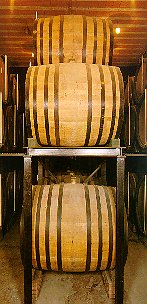
The lower the alcohol content, the greater the aromatic component. There are two ways of securing its formation: refinement for a few months in glass or stainless steel receptacles, or ageing in wooden casks.


Last updated 30-Jun-97
Webmaster Elsy : elsy@itbiz.com