
The colosseum?
It's Near Bra
As we wander through the countryside around Bra, we come to Vezza d'Alba, which has been the site of a parish church since the early Middle Ages, when it was founded as part of the see of the Bishop of Asti in 1041.Vezza d'Alba was governed in loco in the 12th and 13th centuries by vicars, then ceded by the Bishop to the De Ponte family in 1377, and sold by the latter in 1401 to the Roeros. Only a few remains of the donjon have survived the once powerful castle, home of the Roero di Vezza family until the end of the seventeenth century. The parish church of San Martino on the hill of the same name is a large building dating from 1665, enlarged in the mid-nineteenth century by the addition of side aisles. The baroque church of San Bernadino was erected in the second half of the eighteenth century, and its bell tower was completed in1792.
In 1631, Cherasco was selected as the venue for peace negotiations among warring fachons in the Monferrato war. Among the plenipotentiaries was a young prelate named Giulio Mazarino, the pontifical legate, destined to become the French statesman, Jules Mazarin. Saluzzo's Torre Civica.
Continuing our itinerary, we come to Pollenzo, once a Roman town but today a minor suburb of Bra. More than any other such place, however, it has kept to the lines of its original plan, especially in the socalled Borgodel Colosseo, built over the foundations of the Roman amphitheater: the elliptical cavea is clearly visible in the upper part of the town. The other facet of Pollenza is neo-Gothic, built for the Savoys, with an extensive hunting reserve and themonumental complexof the Piazza Vittorio Emanuele II. Cherasco, on the other hand, dates from the late Middle Ages; it was rebuilt completely in 1243 on the broad terrace of the triangle where the Stura di Demonte and Tanaro streams meet.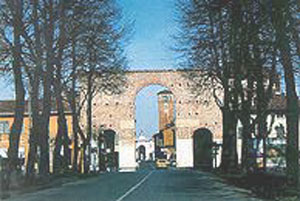
The plan of this aristocratic town is strictly quadrilateral, with broad streets at right angles to each other, lined with arcades and graced by a series of noble mansions and churches, all of them from either the Romanesque or the Baroque periods. Defensive needs dictated the building of imposing fortifications; today the walkway along the bastions which leads to the Visconti Castle is built over their remains; it was extensively reconstructed in the nineteenth century. When Cherasco became the summer home of the Court in the eighteenth century, its urban design was in part remodeled, with the creation of new walls, arches and gateways, and it is to this era that the Palazzo Samatoris and the Jewish Ghetto belong; from the latter,a few houses and the synagogue have survived. A trapezoidal plan with well-defined boundaries shows the military function of Canale, a town that was completely refounded by the Commune of Asti in 1250. It still has some interesting arcading in the central Via Roma, on which there are also several baroque churches. The Malabayla Castle dates from the sixteenth century, while the ancient parish church of San Vittore stands on the site of a previous early medieval settlement. We end our trip in one of the most fascinating towns in Piedmont, Saluzzo (345 meters -16,000 inhabitants; 48 km fromBra). Saluzzo has retained its centuriesold aristocratic character in its town plan and the architecture of its old center.The more modern part of the city stands on the slopes running down to the plain. On the Salita del Castello which leads to the Castiglia there are a number of noble houses, including the former Town Hall with its fifteenth century Civic Tower, and the Guildhan. Nearby is the church of San Giovanni, in the Gothic style, a notable monument, as is the Casa Cavassa, dating from the Renaissance and now a civic museum. Saluzzo is famous for a long tradition of craftsmanship in furniture and restoration,which is still celebrated in important national fairs in May and September.
B.B.


Last updated 02_May-98
Web made by Elsy snc Send mail to: elsy@itbiz.com